
Elevator Poker is Texas Hold'em where the board only goes one way: up. Every time cards hit the board, the lowest card on it is taken away and a new card from the deck goes in its place. Low cards don't last, so boards are full of high cards and big hands.
How a hand plays
- Blinds and two cards each, then a round of no-limit betting, as in Texas Hold'em.
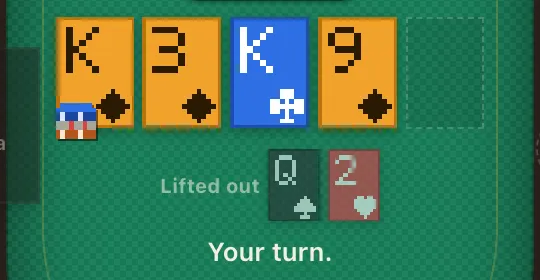
- The flop. Three cards are dealt, then the lowest of them is replaced by a new card.
- The turn. One card is dealt, then the lowest card anywhere on the board is replaced. That can be a flop card.
- The river. The same again: one card, then the lowest card on the board is replaced.
- Betting happens after each replacement, so you always bet on the finished street.
- Showdown. The best five cards from your two and the board win.
Which card goes
- Aces are high, so an ace is never the lowest card unless the whole board is aces.
- Ties go by suit. If two cards share the lowest rank, the lower suit goes: clubs, then diamonds, hearts and spades.
- The new card stays, even if it's lower than everything else. It can be the one replaced on the next street.
What changes
- High cards win more. Low pairs and small straights get broken up when their board card is lifted out.
- Broadway hands are strong. Boards drift towards tens, jacks, queens, kings and aces.
- Your hand can get worse. If you paired the lowest card on the board, the next street will take it away.
Tips
- Play big cards. A-K, K-Q and pairs of tens and up gain the most. Hands like 6-5 suited lose value.
- Count what's lowest. Before the turn, look at the lowest card on the board: that's the one likely to go.
- Watch the lifted cards. They're out of the deck, so they tell you what can't come.
Play it
Play Elevator Poker on Bink, for play money. Bink deals each street, lifts out the lowest card and deals its replacement for you.