Every poker game that plays for the best hand uses the same ten hands, from a royal flush at the top to high card at the bottom. Learn this list once and it works for Texas Hold'em, Omaha, Seven Card Stud and most of the variants on Bink.
A hand is always exactly five cards. In Hold'em you have seven to choose from (your two and the five on the board), and you use the best five.
Poker hands from best to worst
1. Royal flush
Ace, king, queen, jack and ten, all the same suit. It's simply the best possible straight flush, and you may play for years without making one.
2. Straight flush
Five cards in a row, all one suit. If two players have one, the higher top card wins.
3. Four of a kind
Four cards of the same rank, plus any fifth card. Also called quads.
4. Full house
Three of one rank and two of another. Said as "jacks full of fours". Between two full houses, the three of a kind decides it first.
5. Flush
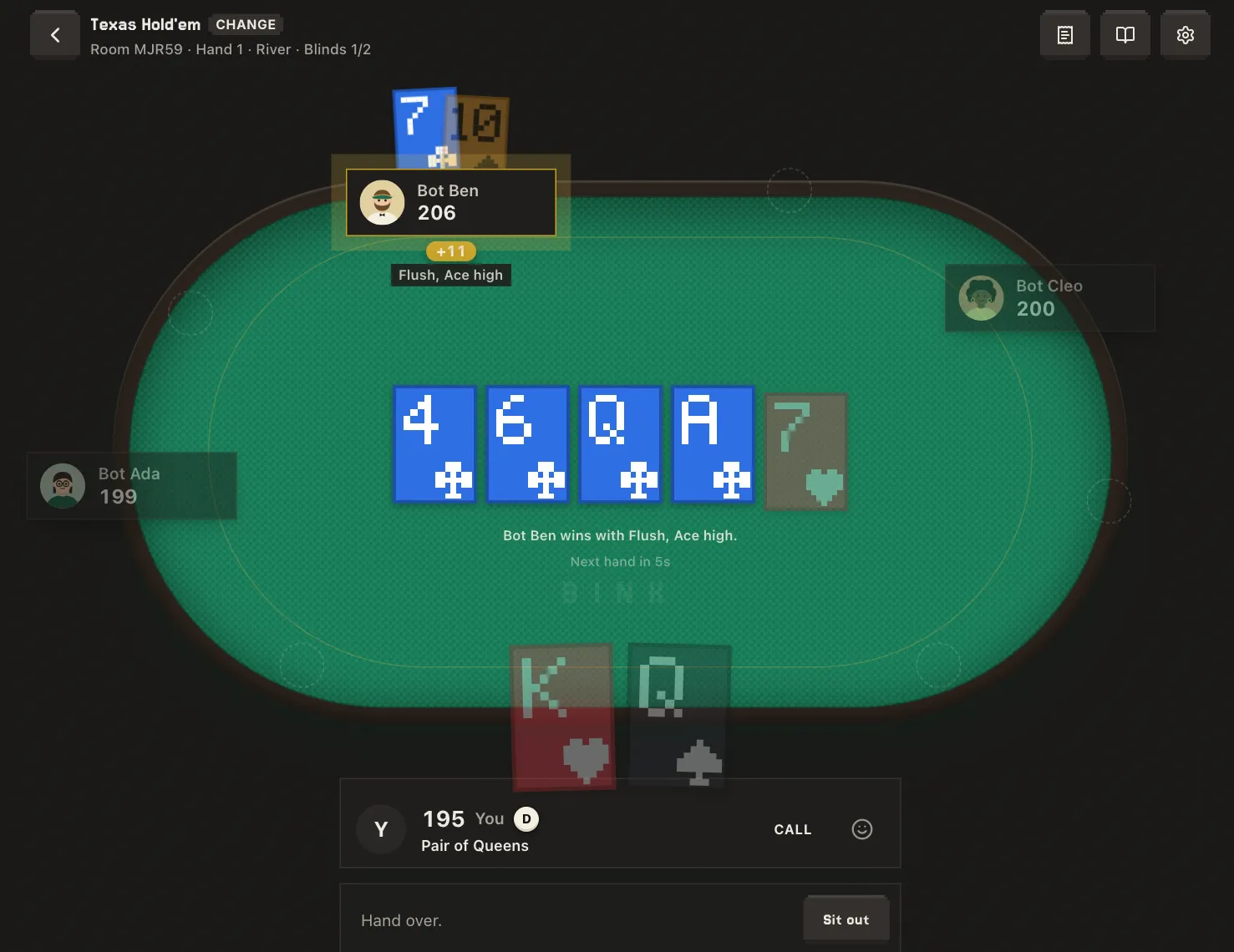
Any five cards of the same suit. They don't need to be in order. Between two flushes, compare the highest card, then the next, and so on.
6. Straight
Five cards in a row, in any suits. The ace can be high (A K Q J 10) or low (5 4 3 2 A, called the wheel), but a straight can't wrap round: Q K A 2 3 is not a straight.
7. Three of a kind
Three cards of one rank. In Hold'em, three of a kind made with a pair in your hand is called a set, and with one card in your hand and two on the board, trips.
8. Two pair
Two cards of one rank and two of another. The higher pair is compared first, then the lower pair, then the fifth card.
9. One pair
Two cards of the same rank. Ties go to the higher pair, then the highest of the other three cards.
10. High card
Nothing else. The hand is named after its highest card, "ace high", and ties go card by card down the hand.
How often you'll make each hand in Hold'em
These are the chances that your best five cards out of seven (two in your hand, five on the board) make each hand, if you stayed in for the river every time.
| Hand | How often |
|---|---|
| Royal flush | 0.003% (about 1 in 31,000) |
| Straight flush | 0.03% |
| Four of a kind | 0.17% |
| Full house | 2.6% |
| Flush | 3.0% |
| Straight | 4.6% |
| Three of a kind | 4.8% |
| Two pair | 23.5% |
| One pair | 43.8% |
| High card | 17.4% |
The rarer a hand, the higher it ranks. That's the whole reason a flush beats a straight.
Breaking ties
- Only five cards count. If you have three pairs in Hold'em, only the best two play, plus your best other card.
- Kickers decide equal hands. A♠ K♣ and A♦ Q♥ on a board of A 8 6 4 2 both make a pair of aces, but the king beats the queen.
- Suits never break a tie. Two identical hands split the pot.
- The board can play. If the five board cards are better than anything you can make, everyone still in plays the board and splits.
Questions players ask
Does a flush beat a straight? Yes. A flush beats a straight, and a full house beats a flush.
Does three of a kind beat two pair? Yes, always.
Is an ace high or low? Both. It's the highest card, but it can also be the bottom of a 5 4 3 2 A straight.
What beats a full house? Four of a kind, a straight flush and a royal flush.
Games where the rankings change
A few variants turn the list around. In Short Deck Hold'em a flush beats a full house, because with no 2s to 5s flushes are harder to make. In 444 fours are wild, so five of a kind is possible and tops the list. And in Badugi the lowest hand wins.
Practise it
The quickest way to learn the rankings is to play. On Bink your hand is named for you under your cards as the hand plays out ("Two pair, queens and eights"), so you never have to work it out alone. Open a Texas Hold'em table with friends, or add bots to the empty seats and play a few hands on your own, all for play money.