Omaha is the second most played poker game after Texas Hold'em, and it plays almost the same way: blinds, a flop, a turn, a river and the same hand rankings. The difference is that you get four cards instead of two, and you must use exactly two of them. It's nearly always played pot-limit, which is why you'll see it called PLO, for Pot-Limit Omaha.
How a hand plays
- Blinds. The two players left of the button post the small and big blind.
- Four cards each. Everyone gets 4 cards face down.
- Preflop betting. Starting with the player left of the big blind.
- The flop. Three cards face up in the middle, then a round of betting.
- The turn. A fourth board card, then betting.
- The river. A fifth board card, then a last round of betting.
- Showdown. Best five card hand wins, made with exactly two of your cards and exactly three from the board.
The rule everyone gets wrong: two and three
In Hold'em you can use any five of your seven cards. In Omaha you must use two cards from your hand and three from the board. Not one, not three, not four.
The board has four hearts and you hold the A♥. In Hold'em that's the best possible flush. In Omaha it's nothing, because you'd be using one card from your hand and four from the board. Your best hand here is ace high.
The same goes for straights and full houses:
- Four to a straight on the board needs two cards from your hand that complete it.
- Three of a kind on the board gives you a full house only if you hold a pair. One card of that rank in your hand doesn't help, because three from the board plus one from your hand is four cards.
Pot-limit betting
PLO is pot-limit: the most you can bet is the size of the pot. To raise, you can make it as big as the pot would be after you called.
If the pot is 100 and someone bets 50, the most you can raise to is 250: your 50 call makes the pot 200, and you raise 200 on top of it. A quick way to work it out is three times their bet plus what was in the pot before it. There's more on this in our guide to poker betting rules.
Starting hands
With four cards there are a lot more ways to make a hand, so hands that look good in Hold'em are weaker here.
- Good hands work together. A♠ A♥ K♠ K♥ (two aces, two kings, both suited) is one of the best. All four cards help.
- Connected and suited cards like J♥ 10♠ 9♥ 8♠ can make lots of straights and two different flushes.
- A lone pair of aces with two unrelated cards is weaker than it looks.
- Avoid "dangler" hands where one card doesn't fit with the others, and three or four of one suit, which takes away your own flush cards.
How Omaha differs from Hold'em
- Hands are bigger. Straights, flushes and full houses win far more pots. Top pair rarely wins a big one.
- Draws are stronger. With four cards you can have a straight draw and a flush draw at once, sometimes with more than 15 outs. See poker outs and odds.
- Play the nuts. The best possible hand (the nuts) matters more, because someone often has the second best.
Omaha games on Bink
Bink plays Omaha in a few forms:
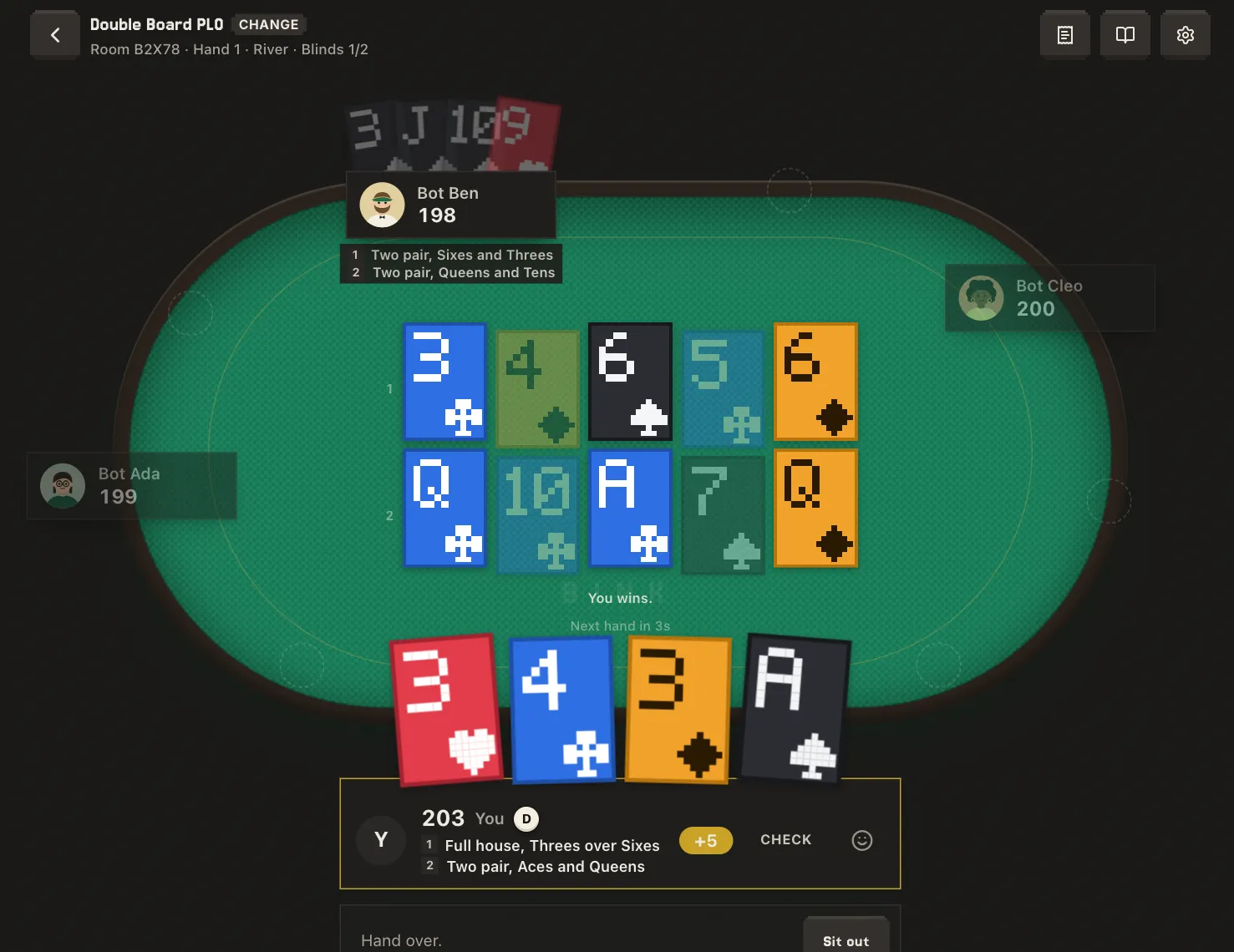
- Double Board PLO: two boards, half the pot each.
- Double-board bomb pot and triple-board bomb pot: everyone antes and the flop comes straight away.
- Pot or Fold: no betting, just pay the price or fold.
Bink checks every hand for you and shows what you've made under your cards, so the two-and-three rule never catches anyone out.