Most home games add a few rules of their own on top of the game: a straddle, running it twice when someone's all in, a bonus for winning with 7-2. Here's what each one means, why groups like it, and the details worth agreeing before you start.
Straddle
A straddle is an extra blind, usually double the big blind, posted by the player after the big blind before the cards are dealt. In return they act last before the flop, even after the blinds.
Why play it: pots get bigger, and players can't just limp in cheaply.
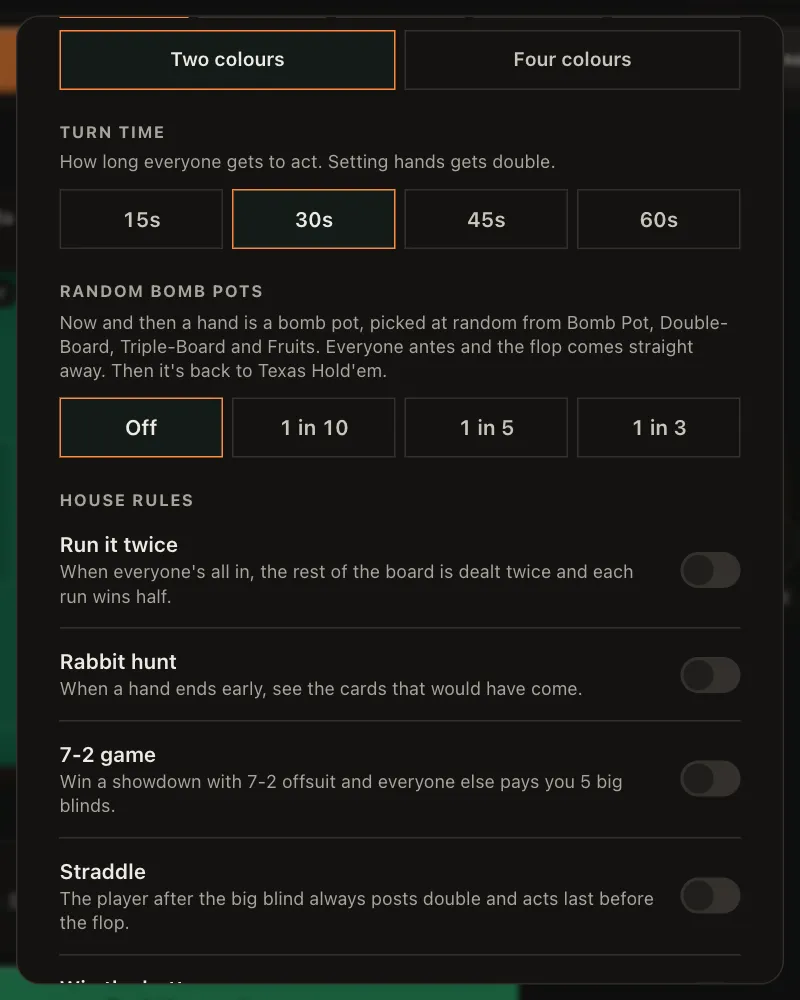
Agree first: whether it's optional or every hand, and whether anyone else can re-straddle. On Bink, the host switches it on and the player after the big blind straddles every hand.
Run it twice
When players are all in before the river, the rest of the board is dealt twice. Each run wins half the pot.
Why play it: it takes some of the luck out of big all ins. A player who's 75% to win will usually take at least half, and often all of it.
Agree first: whether it's automatic or the players choose each time. On Bink, when the host turns it on, every all in before the river runs twice.
Rabbit hunt
When a hand ends early because everyone folded, rabbit hunting shows the cards that would have come.
Why play it: curiosity. Nothing changes hands, but everyone gets to see whether that fold was right.
Agree first: nothing really. It costs nothing and slows nothing down when it's done for you.
The 7-2 game
7-2 offsuit is the worst starting hand in Hold'em. In the 7-2 game, anyone who wins a pot with it gets a bonus from everyone else at the table.
Why play it: it makes people bluff with the worst hand, and it makes every 7 and 2 on the board interesting.
Agree first: the bonus amount, and whether you have to show the hand. On Bink, winning a showdown with 7-2 offsuit gets you 5 big blinds from everyone else. There's a whole guide to the 7-2 game.
Win the button
In win the button, the player who wins a hand deals the next one, instead of the button moving one seat left.
Why play it: it rewards whoever's running hot, and in dealer's choice it means the winner picks the next game.
Fire truck
Win three pots in a row and you've earned the fire truck: everyone else at the table pays you a bonus.
Why play it: it gives a hot streak a prize, and makes everyone else fight a little harder to stop it.
Agree first: the bonus, and whether a split pot counts. On Bink, three pots in a row gets you 3 big blinds from everyone else, and the count starts again.
Poker bingo
Every seat at the table is a square on your bingo card: the button, the small blind, the big blind and the rest. Win a pot from a seat to mark it off. Mark off every seat and you've got bingo.
Why play it: it rewards winning from bad positions, like the blinds, where most players give up.
Agree first: the prize. On Bink, a full card gets you 10 big blinds from everyone else, and everyone's card starts again. Your progress shows in the middle of the table.
The suits game
Four players each own a suit, and the flop pays out:
- A flop all of one suit: that suit's owner is paid 2 big blinds by each other owner.
- A rainbow flop (three different suits): the owner of the missing suit pays each other owner 1 big blind, 2 if the flop has a pair, 3 for trips.
Why play it: every flop matters, even to the players who folded.
Agree first: who has which suit, and whether someone has to call it. On Bink, the first four players dealt in each get a suit, keep it while they play, and the flop pays out by itself.
The FU chip
Whoever wins the first pot gets the FU chip. If they then lose a big pot at a showdown, they can play the chip on the winner, who has to sit out the next 3 hands. The chip then goes to whoever wins the next pot.
Why play it: revenge, mostly.
Agree first: what counts as a big pot, and whether the player sitting out still posts blinds. On Bink, a big pot is 20 big blinds or more, and a player sitting out doesn't post anything.
Random bomb pots
Now and then, a hand is a bomb pot: everyone antes, nobody bets before the flop, and the action starts on a big pot. See how to run bomb pots.
Agree first: how often. On Bink the host picks about 1 hand in 10, 5 or 3, and each one is picked at random from Bomb Pot, Double-Board, Triple-Board and Fruits. Then it's back to the table's own game.
A turn timer
A turn timer gives each player a set time to act. It keeps the game moving, especially online.
Agree first: how long. Bink lets the host pick 15, 30, 45 or 60 seconds, and gives double for steps like choosing a discard. Anyone can tap for 30 more seconds when they need it.
Changing the game
Plenty of groups play more than one game a night. You can:
- Switch between hands when the table agrees.
- Rotate through a list of games every few hands.
- Play dealer's choice, where whoever has the button picks the next one.
On Bink the host can switch to any game from the table at any time, and the hand being played finishes first. Rotation and dealer's choice are part of Bink Pro. See 61 poker variants to play with friends for ideas.
Setting these up on Bink
Every option above is a switch in the table's settings. Only the host can change them, and a change made during a game starts with the next hand. Open a table and try them out, for play money.